Table of Contents
Building the Transportation Enterprise of 2035
A significant focus of the BeyondTrucks product council work is to define critical skills that will move mid-sized and large transport operations forward. Successfully navigating this changing landscape requires developing distinctive capabilities tailored to a company's strategic position. Our research reveals three capability clusters that will determine competitive advantage:
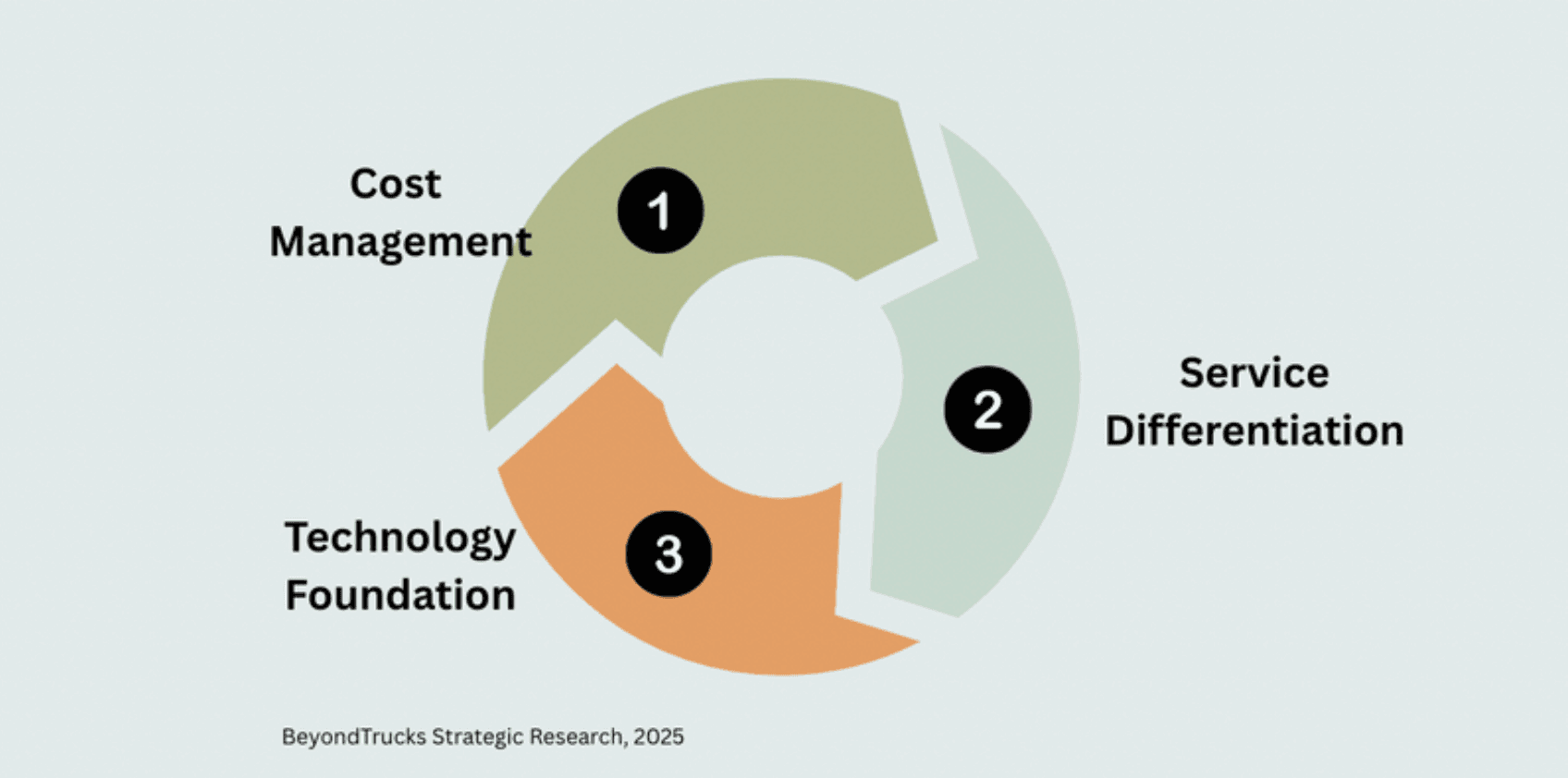
Breakthrough Cost Management
Cost leadership requires excellence across four dimensions:
Overhead reduction through AI-powered dispatch, back-office automation, and process streamlining. Organizations that excel in this dimension typically achieve SG&A costs 3-4 percentage points lower than industry averages. This is where some of the lowest-hanging fruit is located.
Line haul optimization through strategic incorporation of rail and autonomous technologies. Leading organizations are achieving 15-20% cost advantages by systematically evaluating mode optimization opportunities and integrating autonomous capabilities where economically viable. This is harder to achieve in mid-sized and large fleets given the sclerotic
Asset utilization enhancement through advanced analytics and real-time decision support. Leaders in this area achieve 15-25% higher utilization rates for drivers, tractors, and trailing equipment through superior load matching, compatibility optimization, and dynamic routing.
Order-to-cash acceleration that reduces working capital requirements and improves cash flow. Top performers typically achieve a cash conversion cycle 7-10 days shorter than competitors, creating significant financial advantages.
Strong Specialization
Service differentiation increasingly requires capabilities beyond basic transportation:
First/last mile excellence through specialized handling capabilities and value-added services at pickup and delivery points. This becomes particularly important as the "driving part" becomes commoditized through autonomous technologies.
Strategic customer integration through deep data sharing, joint process optimization, and collaborative network design. Organizations that excel in this dimension become embedded in customers' operations rather than serving as interchangeable vendors.
Risk management expertise that positions transportation providers as partners in managing increasingly complex liability exposures. This includes advanced safety technologies, specialized safety or hazmat protocols, and comprehensive risk mitigation programs.
Digital Foundation
Technology capabilities that support both cost leadership and service differentiation:
Modern TMS platforms capable of managing real-time connectivity across a complex technology stacks. These systems must support advanced analytics, adapt rapidly to evolving requirements, and scale efficiently with operations at a cost that doesn’t become a competitive disadvantage.
Data integration and analytics capabilities that generate actionable insights for operational decision-making. Organizations that excel in this dimension develop proprietary data assets that create sustainable competitive advantage.
Automation throughout the value chain, particularly in private fleets, where tie-ins to manufacturing and inventories offer additional opportunities, including demand forecasting, advanced producer and customer inventory management, dispatcher decision support, document processing, and customer communication. Leaders typically automate 60- 70% of routine operational processes.
Winning Strategies by Market Segment
The strategic implications of these industry shifts vary significantly by market segment:
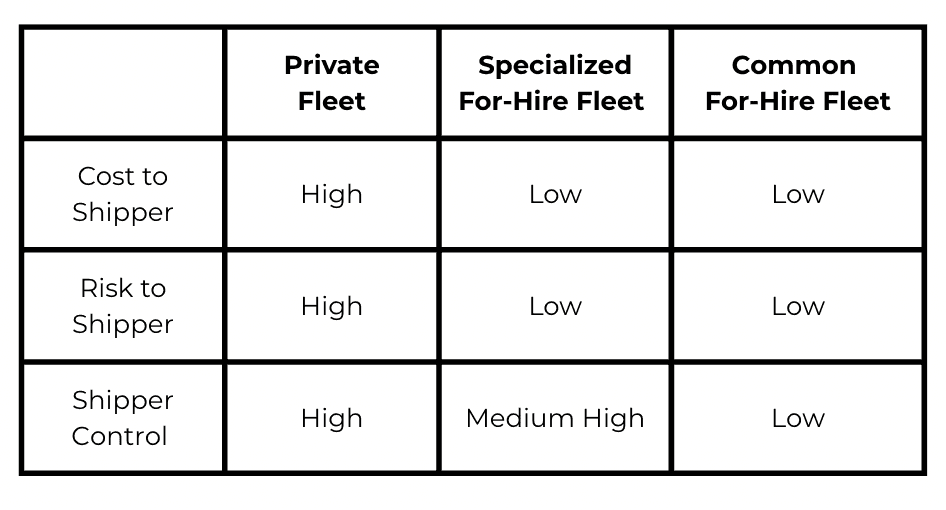
For Private Fleets: Hybrid Excellence
Private fleet operators must answer a fundamental question: Can outside fleets offer more cost-competitive and lower-risk solutions without compromising service quality?
The most successful organizations pursue a hybrid approach that maintains control over critical customer touch points while strategically outsourcing non-core movements, requiring rigorous benchmarking against best-in-class for-hire alternatives with regular make-vs-buy analyses, selective outsourcing based on clear decision frameworks, technology investments enabling real-time visibility across owned and outsourced operations, and quality control mechanisms that maintain service standards with third-party providers.
One major animal feed producer and distributor achieved a 10% reduction in transportation costs while maintaining service levels by implementing this hybrid model, strategically outsourcing 40% of its moves while maintaining tight operational control over customer-facing deliveries using the same technology across private fleet and dedicated carriers, with improvements in operations control allowing the company to increase driver pay rates while still reducing overall cost per mile.
For Specialized For-Hire Carriers: Deep Integration
Specialized carriers must address how to differentiate through service excellence as the "driving part" becomes commoditized, with the most successful organizations positioning themselves as strategic partners rather than interchangeable service providers, requiring specialized expertise development in handling complex cargo or serving challenging environments, operational and informational integration with customers that creates shared processes and information flows such as inventory monitoring of sales to initiate haul off activities or storage tanks to initiate delivery activities, and risk management positioning that emphasizes the carrier's ability to safely handle complex transportation challenges.
One chemical transportation company increased margins by 3.5 percentage points by developing proprietary loading/unloading capabilities that reduced dwell time by 45% and virtually eliminated demurrage claims.
For Common For-Hire Carriers: Segmented Leadership
Common carriers face the most challenging strategic environment, competing in a segment where differentiation is difficult and price pressure is intense, with the most successful organizations pursuing a two-track strategy of relentless cost optimization alongside targeted service specialization, requiring aggressive automation across driving and back-office operations to achieve industry-leading cost positions, network optimization both strategically (terminal location and lane choices) and tactically (load planning) to maximize driver and asset utilization, and targeted service tiers with clear value propositions for specific customer segments.
One major truckload carrier successfully implemented this approach by building an industry-leading cost position through autonomous technology while simultaneously developing specialized services for pharmaceutical transportation that command a 15-20% premium over standard rates.
Implications for Transportation Leaders
The transportation landscape of 2035 will look markedly different from today's industry. Transportation leaders must take decisive action now to position their organizations for success:
1.Conduct a strategic positioning assessment that delivers clarity on where you fall between (i) private fleet, (i) specialty for-hire fleet or (iii) common for-hire carrier. While that answer may seem clear for most fleets today, companies should think of this as a deliberate decision about where to play in 10 or 20 years. For each position, has its own set of critical capabilities that need to be developed for survival and thrival.
2.Develop a capability roadmap that prioritizes investments based on your strategic positioning. This should include specific initiatives across cost management, service differentiation, and technology capabilities.
3.Build partnerships that complement your strategic focus and fill capability gaps. This may include technology providers, specialized service partners, or even strategic relationships with competitors in non- core areas.
4.Create an organizational transition plan that addresses the human capital implications of technological and operational evolution. This should include reskilling programs, organizational structure adjustments, and change management approaches.
The window for decisive action is narrowing. Transportation leaders who delay strategic repositioning risk finding themselves at an insurmountable competitive disadvantage as technology-enabled competitors redefine industry economics.
Those who act boldly now have an opportunity to not just survive but to reshape the competitive landscape in their favor—building transportation enterprises that deliver exceptional value to customers while generating sustainable financial returns.
About the Authors
Hans Galland: Hans Galland is the CEO and Co-Founder of BeyondTrucks. An operator with deep experience in finance and private equity, Hans has brought a unique perspective to technology within the trucking industry. You may contact him by email at hans@beyondtrucks.com.
Dr. Paul Xie: An expert in supply chain management, technology, and product development. Paul became obsessed with dislocations in traditional industries where technology plays a critical role in improving efficiency and resolving frictions. You may contact him at paul@beyondtrucks.com.