The Future of the
Trucking Industry for
Mid & Large-Sized Fleets
Table of Contents
Trucking Management Systems (TMS), which streamline operations and reduce process costs for fleets have evolved rapidly in the last decade. These newer software applications known in this paper as Smart TMSs not only save fleet owners valuable time and money but also enhances overall efficiency by automating menial and repetitive tasks that increase as fleet sizes grow. In addition, the digitization of business processes is poised to transform the country’s trucking carrier base, providing an advantageous position for early adopters while presenting existential threats for those lagging behind.
At the industry level, the adoption of modern STMS will pave the way toward a more seamlessly connected and efficient national transportation system, serving as the cornerstone of America’s world-leading supply chains and robust economy. Transporting more than 70% of the nation’s freight, the trucking industry is crucial to the everyday lives of Americans. Yet, the COVID-19 pandemic exposed vulnerabilities and accelerated the need for change if many trucking businesses will continue to survive at scale.

Technology has changed key aspects of the trucking industry, with three main stages. The first stage was the development of Transportation Management Systems (TMS) as enterprise resource planning (ERP) systems for large fleets in the 1980s. Rudimentary TMS software created the benefit of digital records for large fleets. After the slow development of TMS, mobile technologies gained traction in the mid-2010s, allowing both brokers and operators to digitize. The third stage arrived in 2016, after the Federal Motor Carrier Safety Administration (FMCSA) implemented mandatory Electronic Logging Device (ELD) regulations to enforce driver hours of service and improve safety. Connecting directly to the truckers’ Onboard Diagnostics (OBD) port, these ELDs gathered important information including drivers' hours of service, speed, locations, odometer miles, fuel levels and much more. With few exceptions, ELDs became mandatory across the country in December 2019.
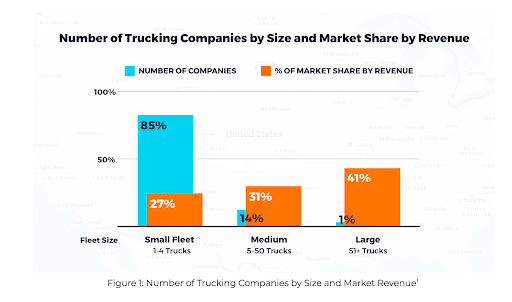
Data from AT Kearney (Figure 1) shows that medium and large-sized trucking companies combine to represent 72% of the market share by revenue in the American trucking industry. In particular, large-sized fleet owners spend excessive time on repetitive tasks like duplicate data entry. Siloed data across multiple applications hinders a holistic business view, leading to errors and limiting the ability to focus on growth-related tasks. Poor integration across technology tools, including TMS software, presents a significant opportunity for future improvement across the American trucking industry.
Unlike rudimentary TMS integrations with other solutions, Smart Transportation Management Software (STMS) tends to be purpose-built to connect operational tasks, creating an efficient workflow. By verticalizing a stack of disparate technologies, STMSs lay the foundation for automating essential yet repetitive work. With connected workflows consolidating data, fleet owners gain a holistic view of their business, enabling the application of advanced analytics, including machine learning (ML), for better decision making. STMSs present a significant opportunity for trucking companies of all sizes to streamline operations and evolve into data-centric organizations, propelling their businesses into the future.
THE EVOLUTION OF TECHNOLOGICAL INNOVATION IN THE TRUCKING INDUSTRY
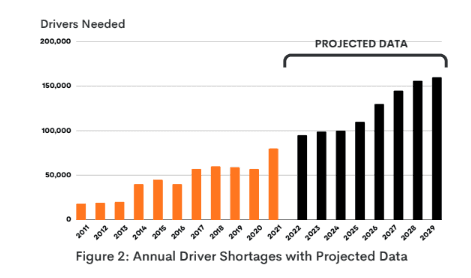
Over the last few decades, technology in the trucking industry has undergone continuous evolution to address diverse needs, ranging from trucker care and safety to fleet management and expansion. In the past 40 years, this evolution can be categorized into three stages: the inception of Transportation Management Systems (TMS), the ascent of mobile technologies, and the implementation of Electronic Logging Device (ELD) regulations.
Transportation management systems (TMS) were first developed in the 1980s. Originally developed as a data storage service, these systems were intended for both large for-hire and private fleets for in-house use. Being the first of their kind within the trucking industry, these TMS softwares, even today, are extremely limited in flexibility and lack workflow orientation, with rare real-time access to carrier data.
Originally tailored for large fleets, the evolution of Transportation Management Systems (TMS) in the trucking industry has brought to light the sector’s inherent fragmentation. Medium-sized trucking fleets, alongside large-sized fleets, hold a significant portion of the trucking market share.
However, they both remain underserved by dedicated software solutions. The substantial costs associated with implementing and maintaining hardware, hiring IT staff, and procuring regular updates have dissuaded both medium and large-sized fleets from embracing TMS solutions.
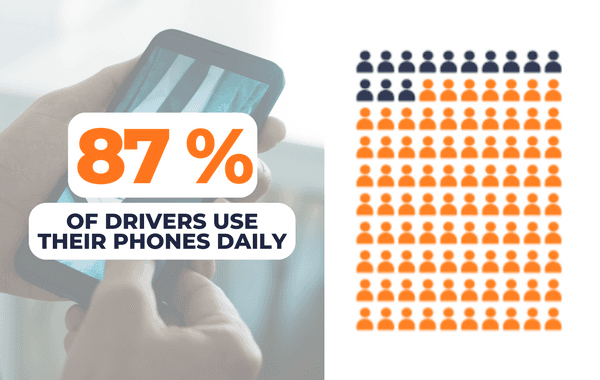
In the mid-2010s, a new wave of technological development encapsulated the trucking industry, namely the development of mobile phone technologies. A 2017 survey conducted by GFK Public Communications and Social, in collaboration with Samsung, found that 87% of drivers used their smartphones every day for work, spending an average of 37% of their day using their smartphones, highlighting a clear area of growth where these cellphone technologies were developed.
Digital freight brokers were crafted for mobile devices, providing brokers with a direct channel to engage with fleet owners and operators. This innovation had a twofold effect, digitizing broker operations, reducing operational costs, and simplifying market access and load-finding processes for trucking companies.
The final and most recent technological stage went into effect in 2016 when the Electronic Logging Device (ELD) mandates were published, following a multi-year attempt to establish mandatory ELD rules. While ELD development began in the 1980s, with motor carriers using them to record hours of service, these devices lacked functionality with minimal abilities. Nearly 30 years later, the FMCSA established ELD rules, which were published in 2015 and included regulations regarding the manufacturing of ELDs as well as tracking hours of service and provisions to protect drivers from harassment.
While ELD mandates are continuously changing and being tightened, the improvement of software has allowed for cloud-based ELDs to be used for real-time data and analysis. Yet, data integration with ELDs has poorly been capitalized on by fleet operators or legacy TMS trucking software, forcing operators to spend unnecessary time switching between ELD software, TMS and load boards, amongst other softwares.
Medium and large-sized fleets have been forced to adapt to these various changes and regulations far more than any other group. With an influx of data, it has only become more expensive and time-consuming to review, and ELD regulations put a further strain on these fleets.
Alongside the many changes the trucking industry has observed throughout the past few decades, the future of the technology within the trucking industry remains uncertain. With the market instability over the past four years, coupled with driver-constrained capacities, the long-range sustainability of many medium and large-sized fleets is uncertain.
Missed Opportunities: Technological Advancements for Medium and Large-Sized Fleets
The rise of artificial intelligence and machine learning are certain to have an impact within the industry, whether within various TMS software, driver care, or many other possibilities.
Optimization is at the forefront of the industry. From tasks such as finding secure, profitable, and convenient routes for truckers to predicting vehicle breakdowns to automating repetitive tasks, these various potential applications of AI are incredibly important for the industry and will save fleet owners' time and money while also ensuring driver safety and efficiency. TMS software built on 1980s or 1990s infrastructure are only slowly adapting to these revolutionary applications if at all.
While AI and ML are pressing issues in space, another future remains unclear; as autonomous vehicle companies such as Volvo and Daimler are competing for authority in this autonomous trucking space, tech startups such as TuSimple, Plus AI, and Einride, as well as heavily established vehicle companies like Tesla and Waymo are all gaining traction in autonomous vehicles. The formation of the Autonomous Vehicle Industry Association signifies that change is on the horizon, as lawmakers and regulators are trying to ensure the safety and benefits of a new future.
THE INTRODUCTION OF SMART TRANSPORTATION MANAGEMENT SYSTEMS OFFER LIGHT AT THE END OF THE TUNNEL
STMSs allow businesses to automate complex and repetitive business processes, streamlining businesses for simplicity and improved service. Truly a leap beyond the older TMS systems, STMS will further ease the process of managing a fleet. Because legacy TMS systems still often do not integrate between various platforms, these STMS have the potential to ease workflow through data integration, a centralized interface and automation, saving operators time and the hassle of switching between various platforms to collect data by being able to collect ELD data, BOLs, PODs, etc.
Over the next paragraphs, we will highlight how STMSs will completely reset the bar for medium-sized fleets. They offer massive opportunities to free up owners and staff, improve customer and driver care, increase margins and allow for efficient scale of medium and large-sized trucking companies.
Thrive & Survive: Navigating Challenges for Sustainable Success
In an industry as competitive as trucking, STMSs will become the dividing line between trucking companies that will flourish and those that will dwindle. In addition, the future of the trucking industry is dominated by the thoughts of self-driving technology. The possibilities appear endless with these technologies, examples being increased road safety and improved efficiency in both speeds and gas consumption. With the growth of autonomous technologies, the industry will undoubtedly be affected.
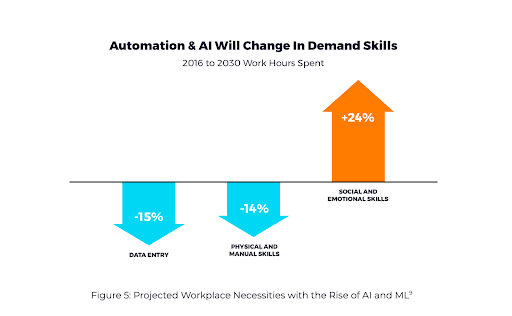
Nonetheless, in an autonomous future, the function of humans will become even more critical. The function of drivers will be different, and more critical: humans will be tasked with safety oversight, delivery in challenging conditions, last-mile delivery, etc. Like in the cockpit of a plane with autopilots, the qualifications requirements of drivers will only go up, not down. From a management and ownership perspective, social and emotional skills will be far more necessary, while the general operation and organizational skills that were previously necessary will be replaced by these AI technologies. More time will be spent on driver care and safety, as well.
Additionally, the trucking company customers will increase their requirements for customer care excellence. Included therein is the ability for their carriers to continuously digitize and give the customer an edge in their supply chain operations.
Being customer centric as a trucking company does not just mean delivering on time and in full, but seeing how you can become a strategic partner of your customer that can ensure their success in competing against other firms. The ability of a sales team to connect, and build strategic alliances and partnerships through digital compatibility will be even more critical.
Finally, owners' time is becoming increasingly valuable. In the near future, owners of sizable fleets will need to reconsider how they utilize their most precious assets: their time, undivided attention, and emotional capacity to connect with others. This shift is essential for them to focus on areas where they can truly make a significant impact.
Imagine living today with a traditional phone, without a computer or a smartphone. STMSs constitute a similar leap in the capabilities of carriers to manage their business. Their adoption will become an existential dividing line to survive.
About the Authors
Hans Galland is the CEO and Co-Founder of BeyondTrucks. An operator withdeep experience in finance and private equity, Hans has brought a unique perspective to technology within the trucking industry. You may contact him by email at hans@beyondtrucks.com.
Matt D’Souza is the Head of Sales & Marketing of BeyondTrucks. Specializing in multi-faceted growth, he brings strategic insight, innovative thinking, and a wealth of experience spanning B2B and SaaS sales, account management, and sales analytics. You may contact him by email at matt@beyondtrucks.com
Beto Wetter is a Research Analyst at BeyondTrucks. He leverages his recent MPhil in History from the University of Oxford to drive thought leadership research for the marketing team, aiding in market proliferation. With a historian’s acumen for trend tracking, Beto combines research and analysis skills to synthesize diverse data points into a compelling narrative and maintains a steadfast passion for the broader strategic landscape. You may contact him by email at beto@awetter.com
Get the "The Future of Mid & Large-Sized Trucking" White Paper in your email inbox