You're Probably Running a System of Record.
Here's Why That's the Problem.
Most fleet software was built to record what already happened. That was enough in 1973. It isn't enough now. Understanding the difference between a system of record and a system of action is the first step toward running a modern operation.
Walk into most fleet dispatch offices today and you'll find something that looks modern on the surface - screens, software, dashboards - but works a lot like it did decades ago. Transactions get recorded after the fact. Decisions get made manually with incomplete information.
The problem isn't the people. It's the type of software and platform they've been given. To understand why, you need to know the difference between three kinds of systems - and what each one can and cannot do for your operation.
The System of Record: Built for Compliance, Not for Operations
The origins of fleet software trace back to something humble: replacing paper. In the 1960s and 70s, digitization meant moving orders, bills of lading, and invoices from physical files to computer storage. The goal was organization, audit trails, and regulatory compliance - not speed, not intelligence, not real-time anything.
Those early systems became the template. TMS and ERP platforms evolved, updated their interfaces, and added features - but their fundamental architecture stayed the same: you run your business, then record what happened.
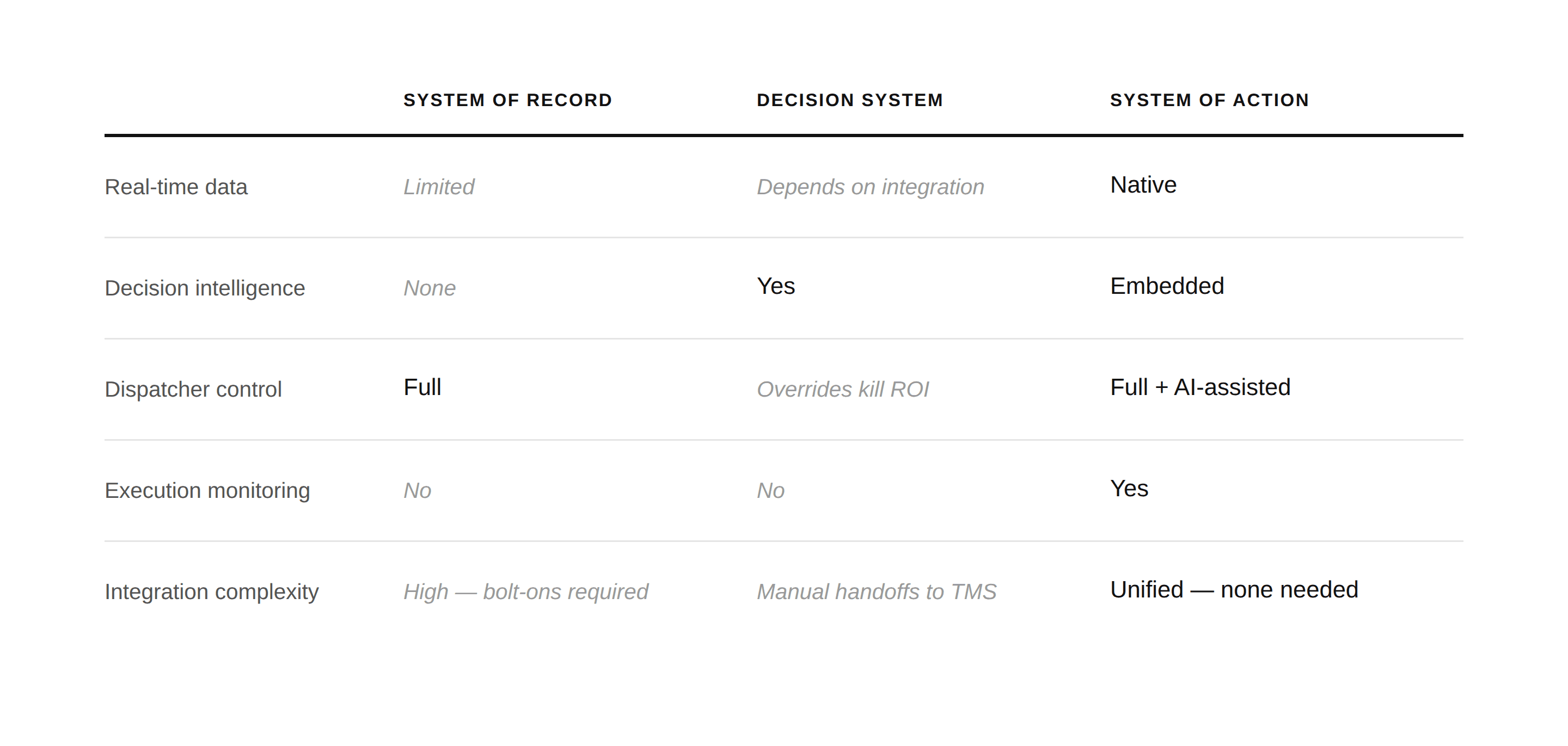
Today, 99% of fleet management tools are still systems of record. They're good at what they were designed for. If you need to document a transaction, generate an invoice, or satisfy an auditor, a system of record does its job. But when the work of operations is happening - drivers in the field, loads shifting, time-sensitive decisions being made - a system of record is watching from the sidelines, not helping.
The core limitation: Without real-time data, a system of record cannot power intelligent decisions. It captures the past - it cannot shape the present.
The Decision System: Smart Recommendations, Broken Execution
Route optimization tools and advanced planning platforms emerged to fill the gap. These "decision systems" apply algorithms and computational methods to prescribe better choices: more efficient routes, smarter load assignments, lower fuel costs. On paper — and in back-test demos - they often look impressive.
But there's a structural flaw. Decision systems live outside the dispatch workflow. When new information hits the floor - a driver calls in sick, a customer changes a delivery window, a load shifts - dispatchers make adjustments in their primary system, not in the optimization tool. The result? Manual overrides that silently erase the ROI.
This is why adoption of decision systems on the dispatch floor is chronically poor. The intelligence is real; the integration into actual work is not.
The System of Action: Where Intelligence Meets Execution
A system of action is built on a different premise entirely. Instead of recording what happened, or recommending decisions from the outside, it operates as the live workspace where work actually gets done - and brings intelligence into that workspace in real time.
Three capabilities define it:
Real-time data capture. Actions are recorded as they happen, not after. This creates a continuous, live picture of operations.
Unified visibility. Driver activity, dispatch decisions, and back-office data are consolidated in a single platform - no stitching together of separate tools.
Native decision intelligence. Optimization and AI recommendations are embedded directly in the dispatcher's workflow - not in a separate tool they have to switch to and then override.
This creates what might be called a virtuous cycle: actions generate data, data informs decisions, and decisions drive better actions. Human expertise and machine intelligence stop working in parallel and start working together.
Where the Real Value Is
Systems of action generate value in three places: operator productivity (fewer manual tasks), error avoidance (automated alerts and checks catch mistakes before they cost money), and resource utilization (better dispatch decisions through embedded optimization).
The biggest leverage is in the field, not the office. Most of a fleet's human and financial resources are tied up in dispatch and driver operations — not in accounts payable. Improving how those decisions get made, and reducing the errors that happen in the field, is where the material impact on a fleet's bottom line lives.
But that value only unlocks if the intelligence is in the same place the work happens. A dispatcher who has to leave their primary workflow to consult a separate optimization tool - and then manually reconcile the difference - isn't gaining the benefit of machine intelligence. They're just doing more steps.
The Right Question to Ask About Your Software or Platform
The question for fleet operators isn't "do we have a TMS?" Most do. The question is: what type of system is it, and where does it actually work?
If your dispatchers are working in one system and your optimization tools are somewhere else, you have a decision system problem masquerading as a workflow. The intelligence never reaches the people who need it - or it does, too late and too separate from the work itself.
The fleets that will outperform in the years ahead are not those that automate the most. They're the ones that equip their people - dispatchers, load planners, operations managers - with the right information, in the right place, at the right moment. That's what a system of action is built to do.
The bottom line: A system of record tells you what happened. A system of action helps you change what's about to happen - while the people who know your operation best are still in control.